Machine Learning Versus Human Judgment in the 2026 FIFA World Cup: A Comparative Analysis of Over 50,000 Tournament Brackets
Riya Deb
Moreau Catholic High School
Abstract
While artificial intelligence (AI) has rapidly advanced to outperform humans in various analytical domains, its predictive accuracy in complex sporting events remains a subject of ongoing debate. This study evaluates the comparative accuracy of a custom-built machine learning pipeline (Goal26) against over 50,000 human-submitted predictions for the 2026 FIFA World Cup. Fifty thousand participants globally submitted tournament brackets via the Goal26 web interface and the partner platform (wcpredictor.app), with brackets scored using a standardized point system and Brier Score analysis for probabilistic calibration. Analysis indicates that the AI model outperformed human predictors across both evaluation metrics. The Goal26 model achieved higher predictive accuracy in total points and demonstrated a lower, more accurate Brier Score than the collective human consensus, indicating structurally better probabilistic calibration. These findings suggest that a machine learning model can effectively capture and quantify the underlying probabilities of high-variance sporting events without the systemic cognitive biases or emotional skew often present in human intuition. Consequently, the study demonstrates that modern algorithmic sports forecasting can surpass the wisdom of the crowd consensus in both deterministic outcomes and risk calibration.
Keywords: Machine Learning, Predictive Analytics, FIFA World Cup 2026, Sports Forecasting, Artificial Intelligence
Introduction
Every four years, the FIFA World Cup captivates billions of viewers and inspires millions of predictions from fans, analysts, and nowadays, artificial intelligence, driven by the rapid rise of generative and predictive models. Despite advances in machine learning and the growing availability of performance data, accurately forecasting tournament outcomes remains exceptionally difficult for both humans and AI. A single upset, squad rotations, or emerging teams can alter the course of an entire tournament, challenging both sophisticated algorithms and human intuition.
In recent years, machine learning has become an increasingly popular tool for sports forecasting, enabling algorithms to analyze historical match results, team performance rankings, and other relevant statistical features to estimate the probabilities of future match outcomes. At the same time, prediction contests and online bracket competitions have demonstrated the effectiveness of collective human judgment, where thousands of independent predictions can be analyzed both individually and as an aggregated consensus. Although both approaches seek to forecast the same tournament, they rely on fundamentally different forms of reasoning. Machine learning identifies patterns within historical data to generate probabilistic predictions, whereas human forecasts often incorporate intuition, recent events, and subjective interpretation.
Despite the growing use of both machine learning and large-scale prediction contests, direct comparisons between algorithmic forecasting and crowd predictions remain limited. Existing studies often evaluate predictive models using historical datasets or compare algorithms against betting markets, while research on human forecasting typically focuses on expert opinion or crowd consensus independently. Few studies have examined how a machine learning model performs against both an aggregated human consensus and the average individual predictor within the same international tournament using measures of both predictive accuracy and probabilistic calibration. As a result, the relative strengths and weaknesses of data-driven forecasting and human intuition remain incompletely understood.
The study addresses this gap by comparing Goal26, a Random Forest-based machine learning model that generates a win, draw, and loss probability for each match, with human tournament predictions sourced via a partnership from an online bracket competition hosted by wcpredictor.app. The human prediction dataset consists of over 50,000 submitted brackets, allowing for evaluation of both aggregate consensus predictions and average individual performance. Predictive performance is assessed using cumulative tournament points and Brier Score Analysis to examine both prediction accuracy and probabilistic calibration. By comparing an independently developed machine learning model with a large-scale human prediction dataset, this study provides insight into the relative capabilities of algorithmic forecasting and collective human judgment in predicting FIFA World Cup outcomes.
Methodology
To predict the outcomes of the 2026 FIFA World Cup, an end-to-end machine learning pipeline was developed to transform historical match data into predictive probabilities. This process was divided into three technical phases.
Data Acquisition and Filtering
A comprehensive dataset of international football match results from Kaggle was utilized to extract historical match features for the model. The dataset was then filtered to only include results from the past 28 years (1998-present) and matches where both participating teams qualified for the 2026 World Cup, ensuring model relevance.
Feature Engineering
To construct the feature set, a rolling "Points Per Game" (PPG) metric utilizing a five-match window was engineered to quantify immediate team form. The pipeline also incorporated an is_host binary feature to account for the well-documented structural advantages associated with hosting—specifically for the USA, Mexico, and Canada—including localized crowd support and the mitigation of international travel fatigue. Additionally, January 2026 FIFA Rankings were integrated to provide a static numerical strength index for each squad, enabling the calculation of the relative "rank gap" between opponents to help the model predict match outcomes. The combination of these features allows the model to incorporate historical performance, host status, and FIFA rankings into its predictions.
Model Architecture and Training
TThe model employs a Random Forest Classifier, chosen for its ability to handle non-linear relationships and noisy sports data more effectively than linear alternatives. The model was trained using an 80/20 train-test split to rigorously validate performance against unseen data, with tree depth restricted to 10 to prevent overfitting and ensure the identification of generalized patterns.
Human Baseline and Consensus Metrics
To establish comparative benchmarks for performance, human prediction data was integrated from the partner platform (wcpredictor.app). Absolute accuracy metrics (total points) by Goal26 were evaluated against the mean absolute points calculated across the individual human participant pool. For the probabilistic calibration metrics, the collective human consensus was derived using an aggregate "People's Bracket" that tracks the round-by-round advancement percentage for each team across the 50,000 participants.
Results
The comparative analysis of the tournament projections revealed distinct performance gaps, with the Goal26 algorithmic model consistently outperforming the aggregate human consensus in both absolute accuracy and probabilistic calibration. Data collection for this study encompasses the tournament's direct-elimination knockout rounds from the Round of 32 through the Semifinals. Note that the Round of 32 is factored into the cumulative Brier Score, whereas absolute point totals (Table 1 and Figure 1) are evaluated from the Round of 16 onward. The initial group stage was excluded from the analytical scope due to its distinct match-point complexities and the large volume of group-stage fixtures, thereby allowing a focused evaluation of the pipeline's performance in high-stakes bracket progression. Due to the timing of the analysis, the Final and Third-Place Play-off matches were also excluded.
Within this framework, absolute accuracy denotes a binary deterministic outcome (correct versus incorrect classification). Because the Goal26 pipeline outputs continuous probabilistic advancements, the team assigned the higher probability is operationalized as the predicted winner. This methodology establishes strict evaluative parity with the predictions submitted through the human participants' brackets. The probabilistic calibration uses the Brier Score to measure how closely the predicted probabilities (from Goal26 and human consensus data) match the actual FIFA results.
| Tournament Phase | Points per Correct Prediction | Maximum Obtainable Phase Points |
|---|---|---|
| Round of 16 (R16) | +50 | 400 |
| Quarterfinals | +80 | 320 |
| Semifinals | +120 | 240 |
Note. Scoring parameters were adapted from the wcpredictor.app framework to establish evaluative parity and standardize absolute accuracy metrics between the Goal26 pipeline and the human participant pool; this matrix serves as the evaluation baseline for the performance metrics illustrated in Figure 1.
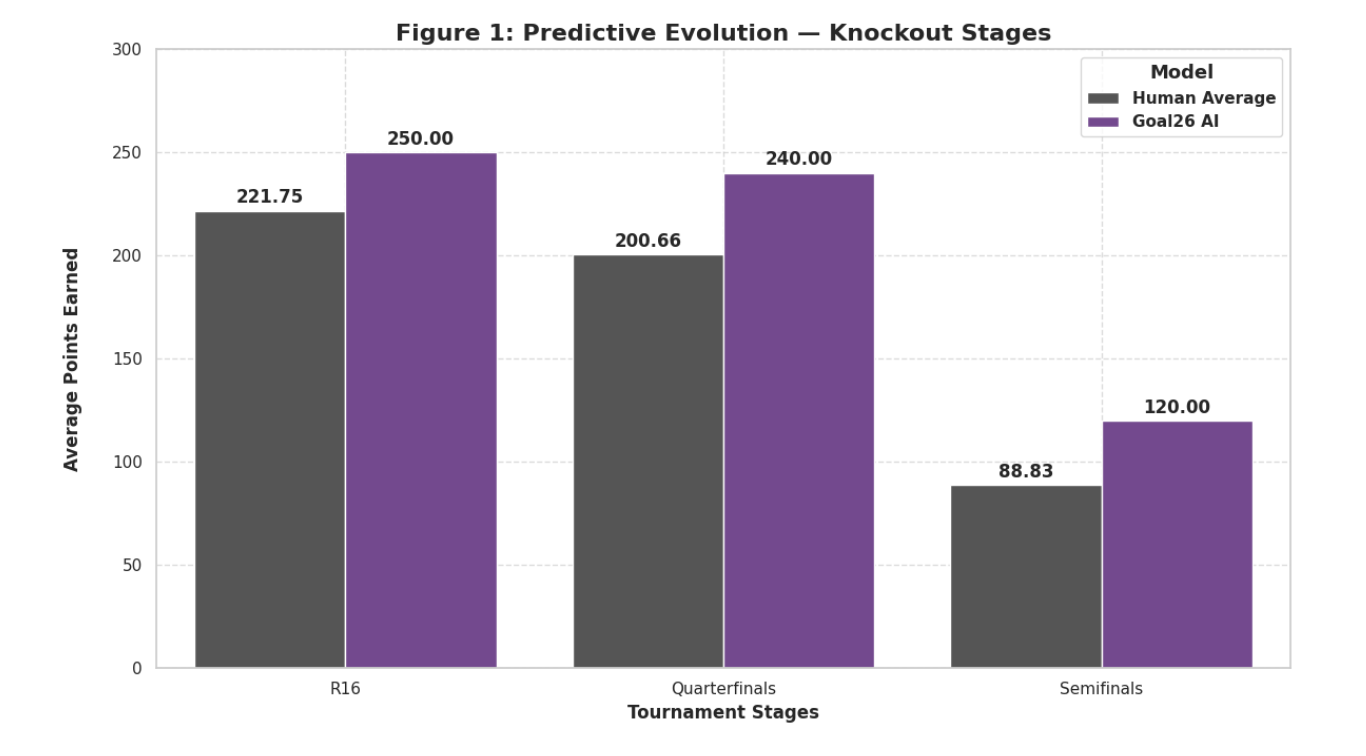
Note. Values represent the single-run absolute points earned by Goal26 alongside the mean absolute points of the human participant pool across each respective knockout tournament round. Maximum obtainable phase values are dictated by the scoring matrix detailed in Table 1.
As illustrated in Figure 1, the predictive performance was tracked across the high-stakes knockout stages of the tournament, specifically the Round of 16 (R16), the Quarterfinals, and the Semifinals. Goal26 scored more cumulative points than the human participants from the Round of 16 to Semifinals. The model maintained this advantage throughout the tournament despite increasingly difficult matchups. The model's ability to maintain its higher accuracy through increasingly complex, elite-level matchups suggests that the Random Forest architecture may have captured systemic tournament dynamics not reflected in aggregate human predictions
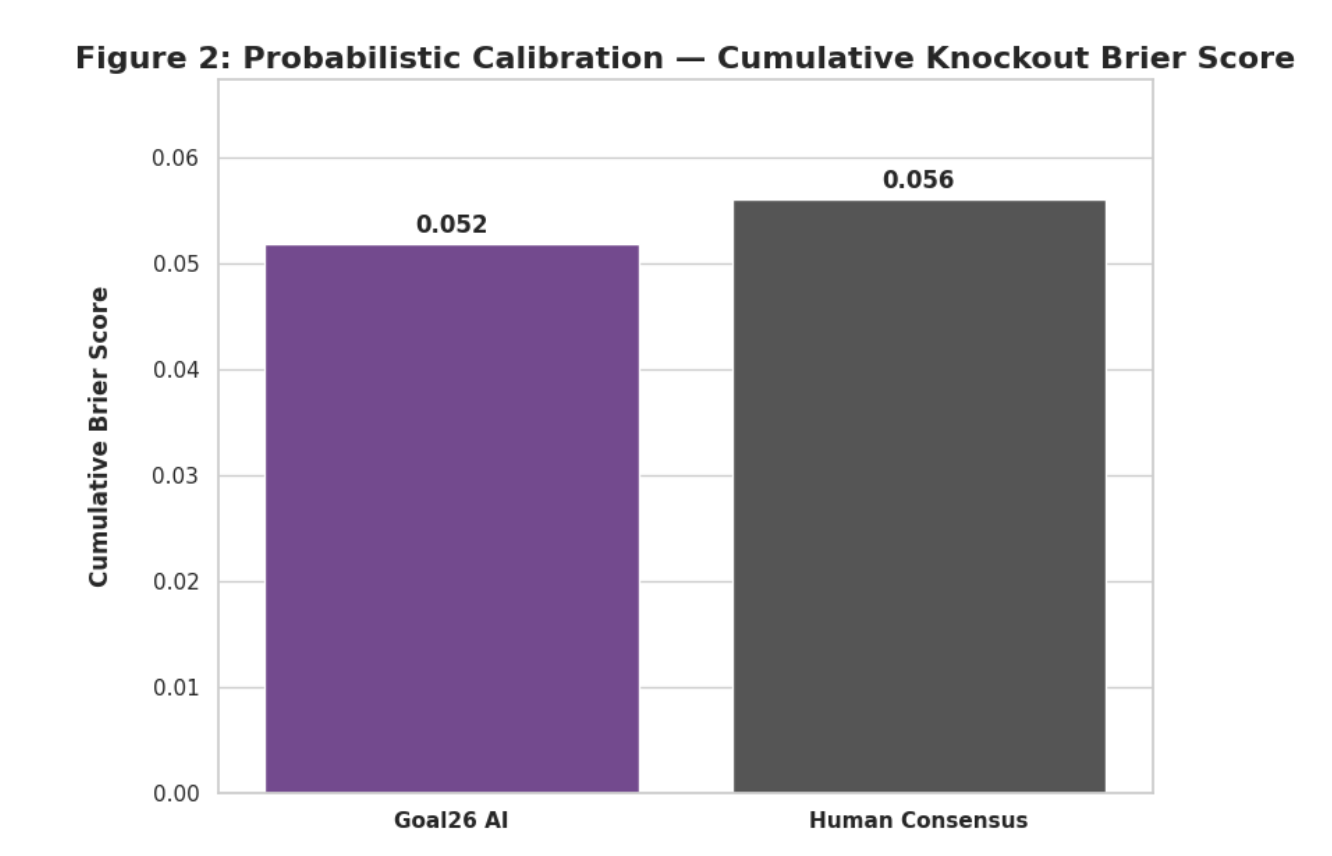
Note. Lower cumulative Brier Scores indicate better probability calibration and a tighter error profile.
Figure 2 presents the results of the Brier Score analysis, which measures the accuracy and calibration of probabilistic predictions where a lower score indicates better alignment with real outcomes. The Goal26 AI model achieved a better, tightly calibrated Brier Score of 0.052, outperforming the majority human consensus, which achieved a higher score of 0.056. This lower Brier Score indicates that the AI model did not merely generate better absolute "picks" (total points), across the tracked Round of 32 to Semifinal matchups, but possessed better calibrated probability estimates of actual risk and uncertainty than the aggregated crowd during the tournament.
Discussion
The results of this study demonstrate that the Goal26 machine learning model performed better over collective human judgment when forecasting complex tournament outcomes like the 2026 FIFA World Cup. By securing a higher cumulative point total alongside a lower, more accurate Brier Score, the algorithmic pipeline demonstrated higher predictive performance. The results across both evaluation metrics suggest that the model generalized well to unseen tournament matches.
The model's dual-metric accuracy suggests that data-driven models, when properly restricted against overfitting, can filter out the statistical noise and systemic cognitive biases inherent to sport spectators. While collective human judgment is often celebrated as the "wisdom of the crowd," human predictors are frequently swayed by qualitative sentiments, historical brand prestige, narrative hype, and media-driven overreactions to recent events. In contrast, the Random Forest model's reliance on objective features—such as multi-year rolling points per game (PPG), relative rank gaps, and localized host advantages—allowed it to compute mathematically grounded probability thresholds that ultimately proved more accurate than aggregate human predictions. By anchoring its classifications strictly within these engineered feature layers, the algorithmic pipeline was not affected by emotional biases that may influence human predictions.
These findings challenge the traditional sports-forecasting paradigm, which posits that algorithms lack the real-time, qualitative contextual knowledge (such as late-breaking injuries or tactical shifts) necessary to out-calibrate human viewers. Instead, the data implies that an unbiased algorithmic processing of team rankings and historical patterns yields a more stable foundation for forecasting high-variance tournaments than mass collective intuition. However, optimized model training cannot completely insulate predictions from error; the inherent volatility of sports introduces external variables—such as immediate match-day anomalies or psychological shifts—that remain fundamentally unpredictable by both humans and algorithms alike. Future research should focus on optimizing the feature engineering of these pipelines further, exploring whether the integration of real-time automated data streams can widen the performance gap between machine learning models and human forecasting pools.
Limitations and Future Directions
While the Goal26 pipeline demonstrated a strong predictive performance compared to humans, several structural limitations qualify these findings. First, the analytical scope was restricted to the direct-elimination knockout rounds (Round of 32 through the Semifinals). The initial group stage was excluded due to its distinct multi-match point complexities, while the Final and Third-Place Play-off were omitted due to the matches not concluding before this paper. Consequently, it remains unverified how effectively the model can navigate the complex tie-breaking mathematics of group-stage play or adapt to the highly volatile, high-pressure psychological dynamics unique to a World Cup Final.
Second, the feature architecture relies primarily on static indices (such as January 2026 FIFA rankings) and short-term historical metrics (5-match rolling PPG). This configuration lacks the capacity to dynamically ingest real-time, qualitative match-day anomalies, including late-breaking player injuries, sudden tactical shifts, or intra-match red cards. Future iterations of this research should investigate the integration of automated, real-time data streams to determine if dynamic feature engineering can further widen the performance gap between machine learning frameworks and mass human prediction pools.
Conclusion
This study evaluated the comparative performance of the Goal26 machine learning model against a crowdsourced dataset of over 50,000 human-generated tournament predictions for the 2026 FIFA World Cup. By analyzing predicted performance through both cumulative tournament points and Brier Score analysis, the result suggests that the Goal26 model outperformed the human prediction pool in this study. Goal26 not only achieved stronger absolute predictive performance in bracket scoring but also exhibited better probabilistic calibration via a lower Brier Score, demonstrating that a robust data pipeline can outperform mass crowd intuition even in high-variance sporting events.
Overall, these findings indicate that machine learning models can provide an effective approach for predicting complex international sports tournaments. By systematically out-calibrating the aggregated intuition of a vast human consensus pool, these results demonstrate data-driven modeling not merely as an alternative forecasting methodology, but provides a useful benchmark for modern sports analytics. While this study establishes independent algorithmic pipelines as a robust baseline, future research should explore whether integrating hybrid human-AI systems can yield further operational optimizations.
References
- Breiman, L. (2001). Random forests. Machine Learning, 45(1), 5-32. https://doi.org/10.1023/A:1010933404324
- Brier, G. W. (1950). Verification of forecasts expressed in terms of probability. Monthly Weather Review, 78(1), 1-3.
- Deb, R. (2026). FIFA World Cup 2026 - Prediction. Goal26. https://www.goal26.app/
- FIFA. (n.d.). FIFA/Coca-Cola Men's World Ranking. Inside FIFA. https://inside.fifa.com/fifa-world-ranking/men
- Jürisoo, M. (n.d.). International football results from 1872 to 2026. Kaggle. https://www.kaggle.com/datasets/martj42/international-football-results-from-1872-to-2017
- Kleos Labs. (2026). World Cup Predictor 2026 — Free Bracket Game. WCpredictor. https://wcpredictor.app/
- Pedregosa, F., Varoquaux, G., Gramfort, A., Michel, V., Thirion, B., Grisel, O., Blondel, M., Prettenhofer, P., Weiss, R., Dubourg, V., Vanderplas, J., Passos, A., Cournapeau, D., Brucher, M., Perrot, M., & Duchesnay, E. (2011). Scikit-learn: Machine learning in Python. Journal of Machine Learning Research, 12, 2825-2830. https://www.jmlr.org/papers/volume12/pedregosa11a/pedregosa11a.pdf